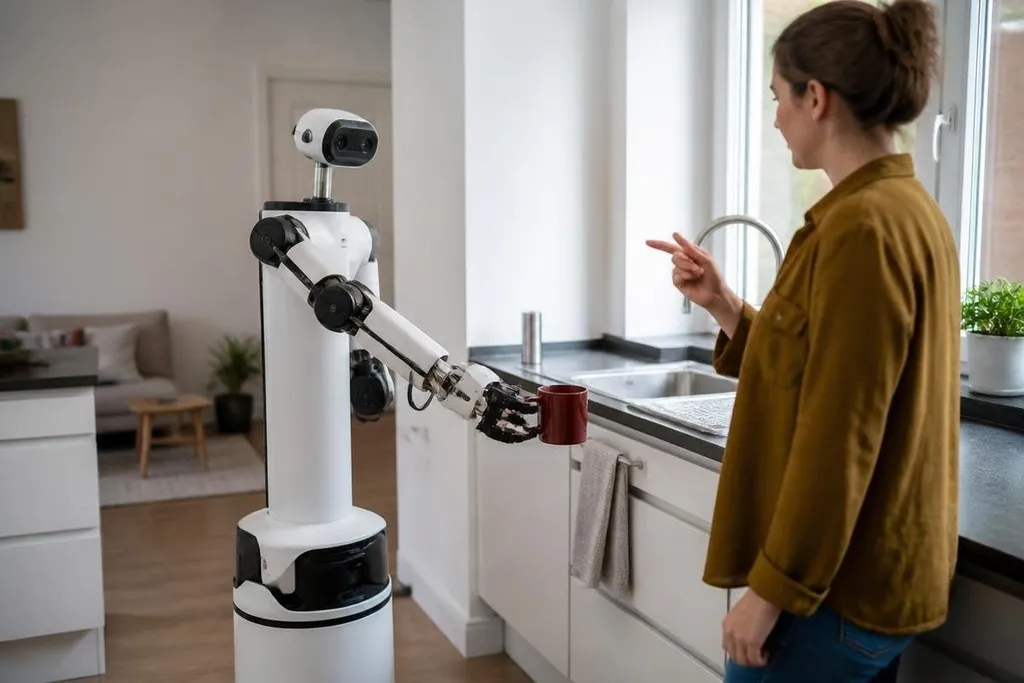
A robot with a camera can spot a cup. A robot with a vision-language model can connect that cup to a spoken request, such as “bring me the cup near the sink.” That link between what a robot sees and what a person says changes how people can give tasks to machines.
Quick read
- Vision-language models connect images, words, and robot actions.
- They help robots handle tasks that were not written as fixed code.
- Safety checks still need separate sensors, rules, and human review.
From pictures to tasks
A normal vision system may label an object as a cup. A language model works with words and instructions. A vision-language model joins those inputs, so the robot can match “red box on the table” with a visible object and a requested action.
The connection matters because robot work often changes from one moment to the next.
A fixed program may expect a box in one marked place. A model can help the robot relate a new position, object, or instruction to the task it already needs to do.
The model does not move the arm by itself. It may produce a goal, a label, or a suggested action. A separate control system turns that output into joint movement, speed limits, collision checks, and motor commands.
This split keeps the roles clear. The model deals with meaning in images and language. The control software handles timing, force, position, and the physical limits of the robot.
Why language changes robot use
Robot programming often depends on exact commands and known layouts. Language gives a person another way to describe a job, ask for a change, or point out an object without rewriting the whole task.
For a warehouse worker, “move the damaged package to the inspection area” carries more meaning than a button marked “route item.” The robot still needs a map, a gripper, and rules for safe movement, but the instruction can describe the reason for the move.
Language also gives the robot a way to ask for help. If two boxes look alike, the system may ask which one the person means. That exchange can reduce errors when the camera view is blocked or the work area changes.
The model's value depends on the rest of the system. A clear instruction cannot fix a weak gripper, poor lighting, a bad map, or a missing safety stop.
Where the model helps most
Vision-language models fit tasks with changing objects and human instructions. They can help sort items by description, find a named object, explain what a camera sees, or choose the next step in a longer job.
A changed instruction lets a developer test the model while the robot and most of its control code stay fixed. The useful question is whether the machine follows the new goal, such as sorting a different object, without a new hand-built routine. A dated Robot24.com report can place that software claim beside the named machine, task, and trial.
The model still needs a link to action. That path may be a list of allowed skills, such as pick, place, open, or move. The robot chooses among those skills, while lower-level software checks whether the action is possible.
The limits that matter
A vision-language model can give a confident answer that is wrong. It may confuse two similar objects, miss a thin cable, or describe a scene without knowing whether the robot can reach it.
Language can also hide missing detail. “Put this away” leaves the storage location open. A person may fill in that gap from context, while a robot needs a map, a known object, or a follow-up question.
Safety needs its own checks. Cameras can miss an object, and the model may not know the force needed to lift it. Emergency stops, speed limits, depth sensors, and human approval remain separate parts of the system.
I'd treat a vision-language model as a task interface, not as the robot's full control system. That view gives the model a useful job while leaving movement and safety to software built for those jobs.
A practical check before deployment
Before adding one to a robot, check these points:
- Name the task: Write down the exact action the robot must complete after each instruction.
- List the allowed actions: Limit the model to robot skills that the control system can check.
- Test unclear language: Try short, vague, and conflicting instructions in a safe test area.
- Check missed objects: Measure what happens when lighting, camera angle, or object position changes.
- Keep a human stop: Give a person a clear way to pause the robot before contact or lifting.
These checks turn a broad language interface into a smaller system that can be measured. The useful question is not whether the model can describe a scene, but whether the robot completes the right task without unsafe movement.
The next step for this technology is better proof at the point where words become motion. Until teams publish failure rates, recovery behavior, and task results on real robots, the model belongs near the control system, not above it.